Your whole team works with AI agents, all the same way.
A two-day, hands-on agentic engineering course for software engineers, QA, analysts and product owners, in the coding agent your team already uses, then mentoring billed by the hour.




EUR 1,500 per participant
- Two days
- remote or on site
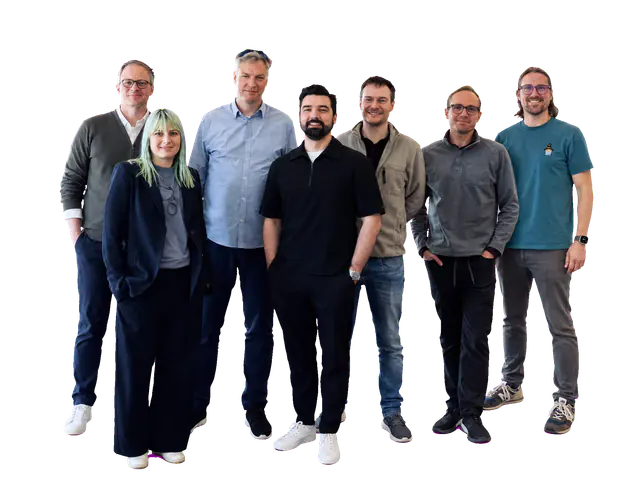
- handpicked trainer
- Format
- Two days, remote or on site, in German or English
- Group
- 8 to 12 participants
- Price
-
EUR 1,500 per participant
Up to 12 people attend, and you pay for 10 at most (EUR 15,000)
Net, plus VAT. On site, plus travel at cost.
- Who delivers it
- AboutOne of our 70+ trainers
- Tailored
- Adapted to your team and stack in a preparation call
- Mentoring
- As needed after the training, EUR 250 per hour, typically EUR 2,000 to 12,000 in total
The sessions got our engineers genuinely excited to try things on their own. That's the hardest part. They kept experimenting, sharing what they built, and asking questions long after the workshop ended.
 Belma Ibrahimović (opens in a new tab)
Head of AI saas.group

What you get in two days
Your team learns the mental models underneath the tools: how agents plan, use context and spend tokens. Afterwards everyone shares one vocabulary and keeps learning together.
Our trainers are practitioners. They start where your team is and leave everyone working with agents the same way, hands-on from before lunch on day one.
Who it's for
The foundation training for software engineers, QA engineers, analysts and product owners.
Product owners can also join Agentic Engineering for Product Managers and Product Owners, with product managers and UX designers: a clickable prototype on day one, specs their engineers' agents can act on by day two.
What your team takes away
- Project rules, agents and skills in your repository
- The handout, for everyone who attends
- Each participant gets their own certificate of attendance
What changes
The goal of the two days: agents fit into every ceremony and the pace lasts. The time agents save in code reaches your customers, because decisions around the code keep up. And your team enjoys working with agents.
What the days cover
Day 1: How AI coding agents work
Day 1: How AI coding agents work
- Framing: how agents change the engineer's job, and why we expect cheaper code to raise demand for engineers.
- How agents work: LLMs, tokens and the agent loop, then a live agent demo.
- First hands-on: everyone uses the agent before lunch, first in an example repository.
- Prompts and setup: the team learns to describe intent instead of giving orders, and sets up project memory.
- Security and efficiency: the team decides what the agent may do without asking, and manages context and tokens.
Day 2: Customize and connect
Day 2: Customize and connect
- Customization: skills (instructions the agent loads when needed), hooks (checks on every agent action), subagents (helpers with their own context) and slash commands (shortcuts for repeated prompts), all built into your repository.
- Build a command: the team builds a command for a task it repeats.
- Integration: MCP, the open standard for giving an agent tools and data, connects it to real systems. The team also sees when a plain CLI call is quicker.
- Spec-driven development: the team writes the spec, the agent builds from it. Then a look at harness engineering, building the context and checks around the agent, and where it is heading.
- Wrap-up: type less, delegate and review more, and what the team takes into its own work next.
Day 3 (optional, EUR 750 per participant, capped at EUR 7,500 per team): Roles
Day 3 (optional, EUR 750 per participant, capped at EUR 7,500 per team): Roles
- One engineering role: how developer, QA and analyst work can grow into one role. What would that mean for each person's job?
- QA owns the gates: QA moves from checking single results to owning the quality of the factory and its gates.
- Continuous ceremonies: each ceremony keeps its purpose but runs continuously, not on a set cadence.
- Patterns from hycle, our open model for running agent teams (opens in a new tab): assumptions to test as the backlog, the daily as a quick agent retro, product and engineering pairing through the day.
How it runs
-
Agents running before lunch on day one
An example repository first, then your codebase. Many teams finish a real feature of their own before the training is over.
-
Real code in your stack
Your team practises on its own code or on one of our training codebases: Python, Java/Spring Boot, Angular/.NET, Kotlin/Vue, PHP, Next.js or embedded C. With its own code, it uses its own machines and licences, and the code stays in your repositories.
-
Mechanics before magic
Tokens and the agent loop first, then the tools. The skills transfer to whatever your company standardises on next. At least one live session takes on a real task from your team as it comes up: a real failure teaches more than a polished demo.
-
Mentoring as your team applies it
We stay with your team while it puts what it learned to the test in real work. Sessions follow the team's progress on real work.
-
Lifetime access to our community
Free for every participant: people from other teams share what works in the hackers&wizards community.
Runs in Claude Code, Codex, GitHub Copilot, Gemini CLI or Cursor.
Trainings by toolWho delivers it
Delivered by one of our more than 70 trainers. For each group, we propose a trainer based on technical fit, language and seniority, and on whether they will get on with that group. In our experience, the personal fit matters most. You accept or decline, then you get to know them and we prepare the training together.
-

Engineering leadership
-

Claude Code specialist
-

Agentic product development
-

Production GenAI systems
A selection from our trainer pool.
AboutAll trainersWhat it goes with
Next comes Agentic Software Factory: Advanced Team Training, for teams who want to run one delivery pipeline the same way. Leaders, product people and everyone else in the company learn the same terms in formats made for them, so they plan together without translating.
What clients say
What clients say about our trainings
From my point of view, day 2 was a success. I think it was very inspiring for all participants. The spark definitely caught, and that was the goal.
 Florian Sauter (opens in a new tab)
CTO EGYM
Thanks again for the great workshop. We enjoyed it very much and took a lot out of the in-depth discussion. The links and materials are very helpful.
 Daniel Gebler (opens in a new tab)
CTO Picnic
Questions before booking
Who is Agentic Engineering for Developers and QA for?
Software and QA engineers, analysts and product owners.
How long does it take, and where?
Two days, remote or on site, handpicked trainer
What does it cost?
EUR 1,500 per participant. Team training, EUR 15,000 at most for the two days: up to 12 people attend, and you pay for 10 at most. Net, plus VAT. On site, plus travel at cost.
A team of fewer than eight pays the same EUR 750 per participant and day, or brings a neighbouring team along.
Is there a third day?
Yes. The same group can add a day on roles after the two days (see the agenda). The day rate applies: EUR 750 per participant, at most EUR 7,500 per team.
Remote or in person?
Both. Remote runs on your Microsoft Teams or Google Meet, cameras on, in a shared repository. On site, we come to you and bill travel and accommodation at cost.
Which tools do you teach?
Our engineering, product and leadership trainings run in the coding agent your team already uses: Claude Code, Codex, GitHub Copilot, Gemini CLI or Cursor. We have delivered each of these trainings in every one of these agents. Agentic Workflows for Business Teams uses a desktop app: Claude, ChatGPT or Microsoft Copilot.
The instruction files, settings and approval modes differ by agent. We set them up with your team on day one. The practice is Agentic Engineering, and it carries over to whatever your company standardises on next.
No coding agent yet? We bring one that fits your team. Licences are on you, whether you supply them or we do.
How quickly can we start?
Plan on about four weeks from the order to the first training day. We agree the date with you, and your team's calendar usually decides it. It can go faster: in 2026, our quickest start came 11 days after the order.
Is funding available?
German companies may qualify for support under the Qualifizierungschancengesetz, depending on the company and the participants. We look at the route with you.
Not sure where to start? Take the self-check