Your next idea reaches customers sooner: AI agents build from your specs.
Two days of AI training for product managers, product owners and UX designers: prototype with agents, then write specs your engineers' agents can act on. Remote or on site.



EUR 1,500 per participant
- Two days
- remote or on site
- handpicked trainer
- Format
- Two days, remote or on site, in German or English
- Group
- 8 to 12 participants
- Price
-
EUR 1,500 per participant
Up to 12 people attend, and you pay for 10 at most (EUR 15,000)
Net, plus VAT. On site, plus travel at cost.
- Who delivers it
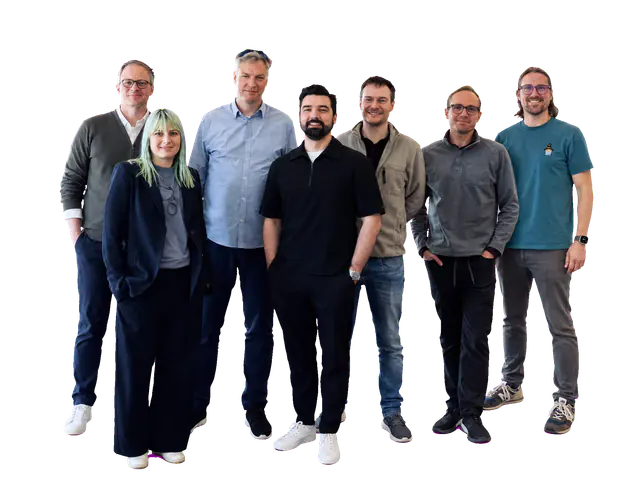
- AboutOften Andreas Stephan or Jan Milz
- Tailored
- Adapted to your team and stack in a preparation call
- Mentoring
- As needed after the training, EUR 250 per hour, typically EUR 2,000 to 12,000 in total
The interactive session helped us plow through a mountain of questions and tactical decisions. Our product-engineering organization now fully embraces agentic engineering patterns.
 Nino Ulsamer (opens in a new tab)
Co-Founder & CTO StashAway

What changes for product
Specs are complete before they reach engineering, so the time agents save in the code shows up for your customers.
Agents are changing the engineer's job, and product is next. This course breaks down the silo between the two: product people learn how to work with engineers who build with agents, and how to get clearer communication from their engineering team.
Who should join
Agentic Engineering for Product Managers and Product Owners is a two-day team training for 8 to 12 product managers, product owners and UX designers, with a handpicked trainer. You learn to work with engineers who build with agents, and to write requirements their agents can act on.
Product owners can take either training: this one with their product colleagues, or Agentic Engineering for Developers and QA to build with agents next to their engineers. Colleagues outside engineering and product, from marketing to finance, pick Agentic Workflows for Business Teams.
What your team takes away
- Specs your engineers' agents can act on
- One vocabulary shared with your engineering team
- A starter kit for daily product work: AI workflows for discovery, requirements and prioritization, MCP configurations for your own tools, prompt templates and a playbook
- A certificate of attendance in your name that confirms the training
What changes
Discovery becomes faster and more grounded. Requirements are complete before they reach engineering. Prototypes emerge within minutes. Most importantly: your product team experiences how AI makes their work better.
What the days cover
Day 1: From idea to prototype, then into the coding agent
Day 1: From idea to prototype, then into the coding agent
- A real product challenge: the team takes a product challenge of its own toward a prototype tested with AI personas.
- Synthetic user research: persona simulation, interview synthesis and insight extraction with an agent.
- Rapid prototyping: a prototype in Lovable or v0, built in structured steps instead of ad-hoc prompting.
- Synthetic user testing: AI personas test the prototype and give structured feedback.
- Into the coding agent: the difference between an LLM and an agent, and why structured context sets the quality of the output.
- The prototype in code: the team sets up its coding agent and extends the morning's prototype at code level.
Day 2: Specs, priorities and roadmaps with AI agents
Day 2: Specs, priorities and roadmaps with AI agents
- Complete specs: from ten-line user stories to specs with edge cases and acceptance criteria.
- MCP for product tools: the agent connected to your own project management and analytics tools.
- Prioritization: impact analysis, RICE scoring and roadmap simulation with an agent.
- A new Definition of Ready: how refinement, planning and review change, with a prototype and requirements tested against AI personas instead of prose tickets.
- Domain knowledge as multiplier: why product owners and UX matter most now.
- Starter kit: prompt templates, MCP configurations and a playbook the team uses the next day.
How it runs
-
Real product challenges
Hands-on, led by practitioners with 20+ years of enterprise experience.
-
Working workflows
Your team works on workflows that run, and the material stays with you.
-
Mentoring as your team applies it
We stay with your team while it puts what it learned to the test in real work. Sessions follow the team's progress on real work.
-
Lifetime access to our community
Free for every participant: people from other teams share what works in the hackers&wizards community.
Runs in Claude Code, Codex, GitHub Copilot, Gemini CLI or Cursor.
Trainings by toolWho delivers it
Often Andreas Stephan or Jan Milz delivers it, otherwise one of our trainers, picked for your team. For each group, we propose a trainer based on technical fit, language and seniority, and on whether they will get on with that group. In our experience, the personal fit matters most. You accept or decline, then you get to know them and we prepare the training together.
-

AI-native product management
-

Product management training
-

Claude team rollouts
A selection from our trainer pool.
AboutAll trainersWhat it goes with
Your engineers learn the same vocabulary in Agentic Engineering for Developers and QA.
What clients say
What clients say about our trainings
The sessions got our engineers genuinely excited to try things on their own. That's the hardest part. They kept experimenting, sharing what they built, and asking questions long after the workshop ended.
 Belma Ibrahimović (opens in a new tab)
Head of AI saas.group
From my point of view, day 2 was a success. I think it was very inspiring for all participants. The spark definitely caught, and that was the goal.
 Florian Sauter (opens in a new tab)
CTO EGYM
Questions before booking
Who is Agentic Engineering for Product Managers and Product Owners for?
Product managers, product owners and UX. For every background: everyone works hands-on with an agent.
How long does it take, and where?
Two days, remote or on site, handpicked trainer
What does it cost?
EUR 1,500 per participant. Team training, EUR 15,000 at most for the two days: up to 12 people attend, and you pay for 10 at most. Net, plus VAT. On site, plus travel at cost.
A team of fewer than eight pays the same EUR 750 per participant and day, or brings a neighbouring team along.
Can our product people join the engineering training?
Yes. Product owners and product managers are welcome in both engineering trainings, AE-DEV and AE-FACTORY, and many teams bring them. If they come without their engineers, or their engineers are already trained, there is a team training for them: Agentic Engineering for Product Managers and Product Owners (AE-PM).
Which tools do you teach?
Our engineering, product and leadership trainings run in the coding agent your team already uses: Claude Code, Codex, GitHub Copilot, Gemini CLI or Cursor. We have delivered each of these trainings in every one of these agents. Agentic Workflows for Business Teams uses a desktop app: Claude, ChatGPT or Microsoft Copilot.
The instruction files, settings and approval modes differ by agent. We set them up with your team on day one. The practice is Agentic Engineering, and it carries over to whatever your company standardises on next.
No coding agent yet? We bring one that fits your team. Licences are on you, whether you supply them or we do.
How quickly can we start?
Plan on about four weeks from the order to the first training day. We agree the date with you, and your team's calendar usually decides it. It can go faster: in 2026, our quickest start came 11 days after the order.
Is there a certificate?
Yes. Everyone gets a certificate of attendance for their LinkedIn profile, confirming they took part in the training.
Not sure where to start? Take the self-check