What moves adoption
Sustained adoption follows dedicated learning time, clear policies, peer mechanisms such as champions and sharing channels, and role-specific workflows packaged for reuse. Top-down usage targets produce compliance theater, and access alone does not produce use.
Written by
-

Benedikt Stemmildt Founder & Co-CEO
Updated:
Getting Started 2
Our position. We would rather state a mandate than run another pilot: a pilot puts the uncertainty on the technology, a mandate puts it on the organization, where it lives (opens in a new tab). Each team then writes one specific, measurable hypothesis about its own work, because generic training at scale produces compliance (opens in a new tab).
Most organizations that changed anything changed the codebase and left people and processes as they were, which leaves the larger lever untouched (Multitudes research (opens in a new tab)).
Which practices raise adoption of coding agents?
What moves adoption is well documented. Top-down 100% adoption targets produce compliance theater, while clear AI policies and dedicated time to learn have a stronger measured effect (DX, AI strategy playbook talk (opens in a new tab)). Multitudes’ survey of 428 respondents ranks peer-to-peer mechanisms (dedicated sharing channels, AI champions, experience-sharing sessions) among the most effective adoption activities, well ahead of best-practice documentation and usage policies; it also found that of organizations that changed anything, 85% changed the codebase and only 13% changed people and processes, leaving the larger lever untouched (Multitudes research (opens in a new tab)). Teams are meanwhile standardizing the workflow itself: shared team-level prompts and rule files with a gatekeeper feedback loop, so every agent deployed against the codebase follows the same conventions (DX Q1 2026 AI-Assisted Engineering Impact Report).
How did companies reach near-full adoption?
Booking.com reached almost 100% adoption through office hours, curated content, and two-day enablement events (day one GenAI education, day two applying it to a real business problem), set daily use as its target after DX data showed developers were most effective using AI daily or at least twelve days per month, and saw developer satisfaction with AI tooling rise 15 points in six months (Tiatra - How Booking.com measures the impact of AI on developer productivity (opens in a new tab)). Intercom made adoption non-optional, rewriting job descriptions so that not using AI is “not meeting expectations,” and deliberately standardized on one deeply optimized platform to escape “model anxiety,” which they compare to the cost of being multi-cloud (Intercom talk - Doubling engineering throughput (opens in a new tab)).
OpenAI’s internal numbers show adoption spreading without a mandate once the tool carries long work. In about four months, finance, recruiting and legal went from near zero to about 90 percent Codex usage, against 99 percent in engineering by June 2026. Non-engineering teams reached about 40 percent while the Codex app still showed code on screen and was hard for them to use, because it already produced documents, presentations and spreadsheets. Between April and May 2026 usage rose from 60 to 90 percent, which the desktop team attributes to the harness handling long-running goals: people keep one thread going for days, and a long-running agent spawns its own sub-agents, so a person runs fewer tasks in parallel. The productivity team names an awareness gap as the remaining brake, with many staff using the agent for one task and learning further uses from teammates by word of mouth. Teams sped adoption by packaging their role-specific workflows as skills and plugins, since a general-purpose agent handed over empty gives a team nothing to start from. The spread also changed who builds the product: domain experts joined the engineering teams to supply the judgment on slides, spreadsheets and reports that developers lack. OpenAI staff work with an unlimited token budget, which an ordinary rollout does not match (The Pragmatic Engineer - Inside OpenAI’s agentic software factory (opens in a new tab), September 2026).
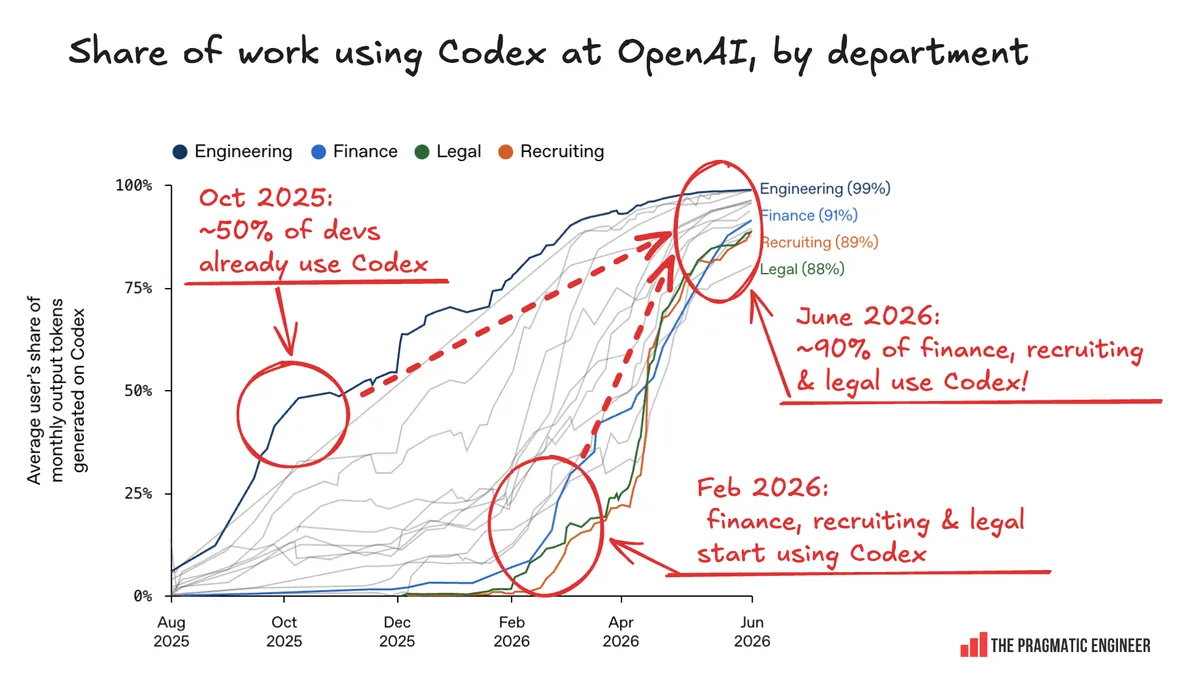
Figure 1. Codex use at OpenAI spread from engineering to finance, recruiting and legal within months, without a mandate. The chart shows the average user’s share of monthly output tokens generated on Codex, per department. Figure from The Pragmatic Engineer - Inside OpenAI’s agentic software factory (opens in a new tab), data from OpenAI.
Why does adoption plateau?
Ceilings and heterogeneity remain: even leading organizations plateau around 60% active usage (DX - Measuring AI code assistants and agents (opens in a new tab)), access does not equal usage (Stanford observed two business units with identical licenses, spend, and tools where adoption diverged wildly) (Stanford - measuring AI ROI talk (opens in a new tab)), and AI amplifies pre-existing engineer archetypes, Builders, Shippers, and Coasters, rather than converting one into another (The Pragmatic Engineer - The impact of AI on software engineers in 2026 (opens in a new tab)).
Related
- Measuring impact: how to tell sustained use from activity.
- Where gains and losses occur: where adoption gains get lost downstream.
- Organizational learning: how individual use becomes team capability.
- Adoption gaps and resistance: why pilots stall even when the tool works.
- Leadership: what leaders own when a team adopts AI.
Resources
Articles
- How Booking.com measures the impact of AI on developer productivity (opens in a new tab) - Tiatra article on Booking.com’s near-full adoption through office hours and enablement events, and its definition of effective daily use.
- Inside OpenAI’s agentic software factory (opens in a new tab) - The Pragmatic Engineer newsletter article on Codex adoption spreading across OpenAI’s departments without a mandate, with internal usage data.
- The impact of AI on software engineers in 2026 (opens in a new tab) - The Pragmatic Engineer newsletter article finding that AI amplifies existing engineer archetypes rather than converting one into another.
Papers and reports
- Measuring AI code assistants and agents (opens in a new tab) - DX research on measuring AI coding tools, noting that even leading organizations plateau around 60 percent active usage.
- Multitudes research (opens in a new tab) - Multitudes survey research ranking peer-to-peer mechanisms among the most effective AI adoption activities, ahead of documentation and policies.
Posts
- A pilot puts the uncertainty on the technology, a mandate puts it on the organization, where it lives (opens in a new tab) - LinkedIn post arguing for stating an AI mandate rather than running another pilot.
- Generic training at scale produces compliance (opens in a new tab) - LinkedIn post arguing each team should write one specific, measurable hypothesis about its own work instead of generic training.
Talks and videos
- Can you prove AI ROI in Software Eng? (Stanford 120k Devs Study) (opens in a new tab) - AI Engineer talk on Stanford research showing identical licenses and tools producing widely diverging adoption across business units.
- How Building with AI Can Double the Throughput of Your Engineering Team (opens in a new tab) - AI Engineer talk on Intercom making AI adoption non-optional and standardizing on one deeply optimized agent platform.
- Leadership in AI Assisted Engineering (opens in a new tab) - AI Engineer talk from DX on AI strategy, finding clear policies and dedicated learning time beat top-down adoption targets.