Abstract
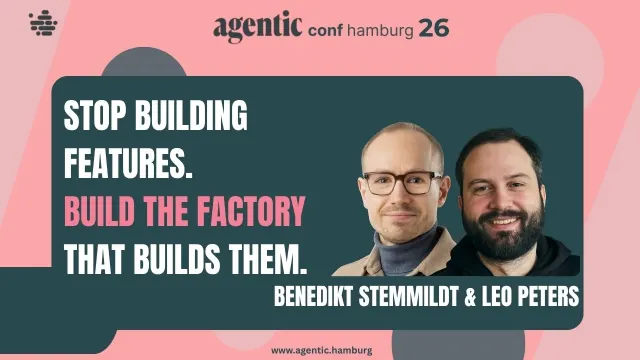
You've got your CLAUDE.md, your subagents, your custom skills. And it works. But every feature still starts with you: kicking off the agent, steering it, reviewing, course-correcting. You've optimized the tool. You haven't automated the process.
The real shift is indirection. Instead of using an agent to build a feature, build a production line that builds features for you. Scripts, validation steps, orchestration, from ticket to pull request with minimal intervention. And don't stop at code. The factory writes tests, generates documentation, handles requirements engineering. Run it in production and let agents react to monitoring data, user feedback, and KPIs. The factory is never done. It grows.
Two hard truths: you can't copy someone else's factory, because it's deeply coupled to your codebase and conventions. And when a new model drops, you rebuild it. That's the new developer skill: not maintaining one perfect system, but rapidly creating factories for any situation.
In this talk, I'll open a real factory from a real client project and walk through how it's built, how it runs, and why this is the path from AI-assisted to genuinely autonomous.
Three takeaways
- There is no factory-in-a-box: your factory is custom because your context is custom. Pre-built solutions assume someone else's context.
- Build incrementally, not big-bang: walk the line manually, script the deterministic parts, connect stations one at a time.
- Engineering judgment matters more, not less: developers need architecture principles and engineering intuition to build good factories. AI tools without engineering foundations produce fragile systems.